

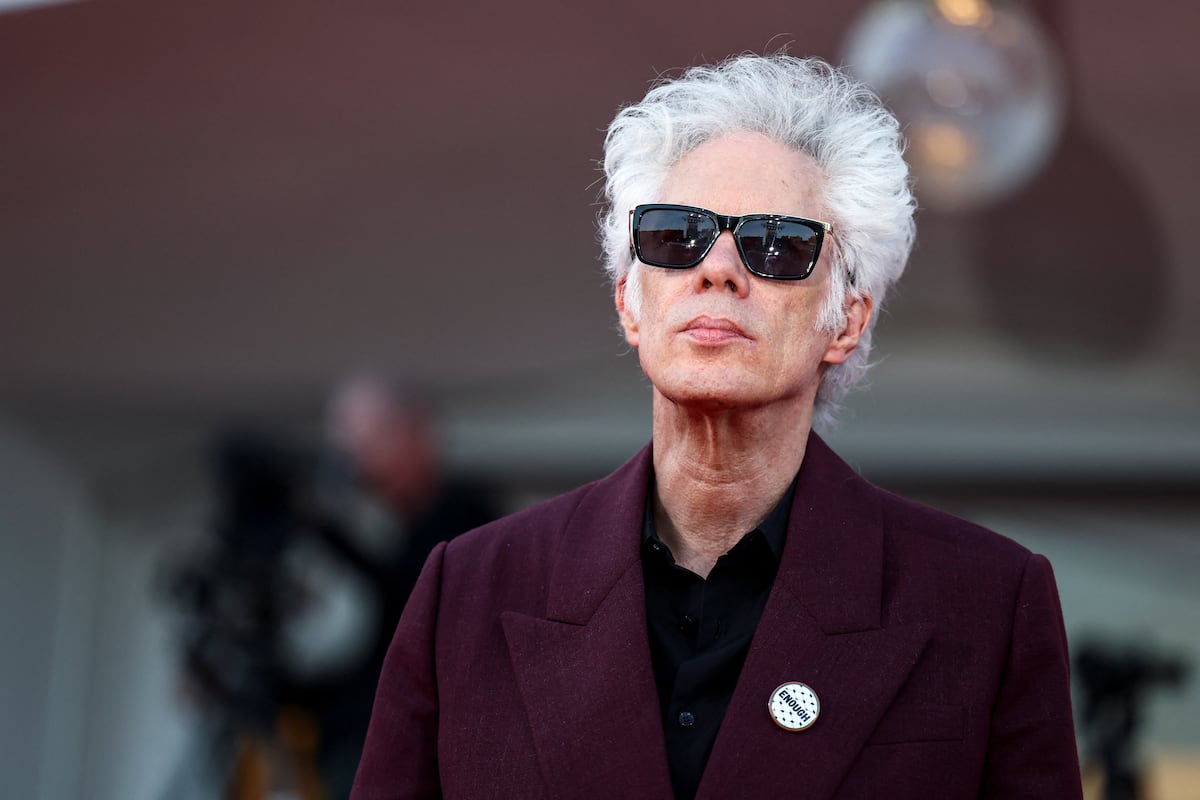
When a movie ends, Jim Jarmusch almost always gets sick. Which illness varies — it could be a cold, the flu, or worse. The phenomenon has taken place for years. In his filmography, the director tends to post more questions than answers. In contrast, when it comes to his health, he has arrived at a clear conclusion: “It’s fucking hard to make a movie. And that’s equally true if it’s good or bad. It requires a lot of resistance and concentration. If you direct and write, you are involved in all the details. People think, ‘Oh, it’s glamourous. You’re with Cate Blanchett, drinking tea.’ They have no idea.” He speaks with all the experience that making 20 films has brought, at the age of 72. Also, the knowledge imparted by lost nights, camera fails, last-minute changes, and the storm that engulfed the locations where he had planned to film a sequence for Dead Man. In response, he has begun to take care of himself physically, and has turned to tai chi. He finds guidance in a quote from his colleague Werner Herzog: “Everyone who makes films has to be an athlete to a certain degree.” In Jarmusch’s case, he is a self-made sportsman, without coaches nor steroids, like a big studio behind him.
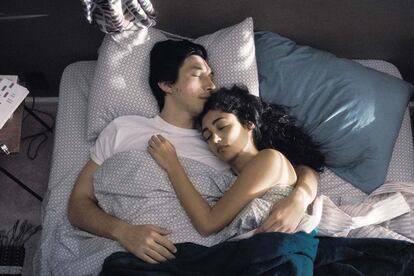
Still, he has recently ascended to great heights: Father Mother Sister Brother, which was released on Mubi last month and received the Golden Lion at the Venice Film Festival. Jarmusch’s first words when he went up to receive the honor were “oh shit.” This could be due to a lack of familiarity from a filmmaker who has been celebrated by fans, but is little used to getting awards. He’s never even been nominated for an Oscar. And that’s having made movies like Paterson, Broken Flowers, Ghost Dog: The Way of the Samurai, Night on Earth and Stranger Than Paradise. Although deep down, this speech opener conveyed a unique, unmistakable, independent creative, in all senses of the word. A guy who confesses to being in love with movies, music, art, human complexity and contradictions. Who is critical of large corporations, Hollywood, nationalism, greed, and Israel’s “genocide” in Palestine. He spoke of all this in Venice, in an interview that he started off with, “I hope that what I’m saying makes sense. I’m quite sleep-deprived.” In the end, the conversation went on for just a half hour, at the director’s request. Once again, Jarmusch establishes his own system.
At this point, it’s clear that he will always opt for freedom — in film, music, and presumably, life itself. His band Sqürl, who latest album is Silver Haze, describes itself as “enthusiastically marginal.” Jarmusch himself has self-identified as an “amateur,” for many reasons, among which is the fact that the word comes from the same origin as “to love”. “I love the shape of cinema, I see a movie every day. But its world really doesn’t affect me,” he says. Basically, he locates himself among the contrarians of Hollywood; perhaps he has been one since his birth in far-away Cuyahoga Falls, Ohio. The son of a businessman and a film and stage critic, he has taken himself even further, to New York and then Paris, to see if his passion for spectacle, concerts, films and counterculture could be turned into a career. He demonstrated that he had talent, and even more than that: coherence. A rarity that, little by little, has taken on legendary dimensions. A white knight, forever wearing sunglasses.
“Being an independent filmmaker means that I choose my collaborators, my cast, the set, the final cut. If you put money into my movie, you don’t tell me how to make it, no matter who you are. [Studio heads] know I’m very hard-headed, and if I don’t get those conditions, I don’t work. ‘We will finance you, but we set the definitive version.’ No thanks. I don’t do this for money, if I did, I’d go to Hollywood. Well, they probably wouldn’t want me. I love film. But I have to make it my way, or I don’t do it,” Jarmusch reflects.
They say he only watches his finished films once, sneaking into a commercial theater with strangers, and then never again. They say that he founded The Sons of Lee Marvin, which also includes Tom Waits, Nick Cave, and others who resemble the famous actor enough to claim a familial connection. He is known to be friends with Aki Kaurismäki, another unique filmmaker, and with several film and music stars who often appear in his productions. Even Jarmusch’s DNA attests to a variated blend: American with Czech, German and Irish roots. Although, he points out, “I don’t like borders and nationalities. I love the particular aspects that distinguish cultures from each other, but also those that combine them and blur the differences.”
In his films, it’s unclear who is the good guy, or the bad guy: they simply feature human beings. And contradictions, like the very ones Jarmusch admits to and embraces. He parades around Venice, he adores Paris, he celebrates the beauty of both cities, while at the same time, denouncing that “they are built atop colonialism.” He considers funding from companies of a certain size to be “dirty,” though he accepts it to push his art forward. He has sworn that Father Mother Sister Brother will not be shown in Israel, but one of his distributors, Mubi, is tied to a defense tech firm founded by former soldiers in Netanyahu’s army. He owns up to such paradoxes: what goes for the characters, goes for their director.
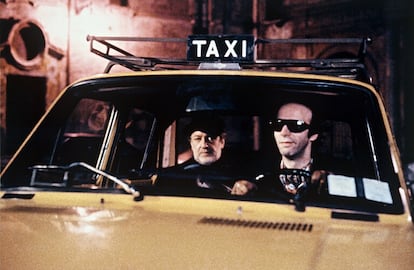
Taxi drivers, dreamers, poets and assassins nearly always concerned with the details of everyday life. In Coffee and Cigarettes, one of his most celebrated works, his avatars merely sit, smoke and sip. “I love human expression and I try to embrace its complexity. Imagination, in a certain way, is my religion,” says Jarmusch. Perhaps even more universal is the center of Father Mother Sister Brother, his new triptych. Fathers, mothers, and children who can’t wait to see each other, but part ways shortly thereafter. Hours that pass too slowly, until they speed up and it’s too late. People who have known each other forever, but sometimes hardly know each other at all. Hugs, glances, nostalgia, weariness, resentment, love. The filmmaker grapples with the greatest of contradictions: family.
Jarmusch knows how to tell all of this through pauses, subtlety, and irony. “The truth is that there are many things that aren’t in this film: no action, no drama, sex, nudity, or violence,” he says. Some of its silences last longer than its dialogues. The creator recalls his visit to the tomb of the Japanese master Ozu, in Kamakura, whose grave bears a single word: 無, or mu. “It means, in a way, the space between things. Sometimes what is not said is more important than what is, like notes that aren’t taken,” he says. He thinks that the final result of Father Mother Sister Brother is very close to how he imagined it at the start, thanks to the fact that he has become more flexible and capable of modifying plans in the moment. It’s all very spontaneous. It’s all, nonetheless, extremely prepared: “It takes a lot of effort for it to seem like there wasn’t any. This film is calm and simple. And that requires a lot of attention to each word and detail. In a certain way, it’s much more exhausting than filming 20 zombies coming out of their graves.”
Which is what happened in his last film, The Dead Don’t Die (2019). Never, since his career began with Permanent Vacation, had Jarmusch gone six years without putting out a film. But at the same time, he’s never made anything he didn’t want to. “In my last feature, they didn’t interfere creatively, but they did with my emotions, repeating things to me like ‘You’ve gone over budget’ and ‘We’re not going to pay you.’ I was filming at the time, still working, I couldn’t deal with it. It was affecting my feelings, my health. I thought, ‘I am not going to die young because of people pressuring me.’ I am very particular, I do things my way. I own the negatives of my films, and also the rights,” he says. The only time he worked with a major studio, things turned out so badly that he’ll never do it again. When he rejected the cuts proposed by Harvey Weinstein to Dead Man, the then-kingpin and owner of Miramax sabotaged the film’s distribution.
“I don’t like to be oppressed by stupid rules,” Jarmusch clarifies. For Father Mother Sister Brother, he had a long fight with a local union rep that continues to rankle. Budget constraints forced him to change the shooting order and film no more than 30 miles from New York — so he went 29.5 miles away, to New Jersey. The auteur insists that he is pro-union and belongs to the Directors Guild, but laments: “They try to protect the workers from large corporations, but that’s not me. So they’re not protecting them from anything. They’re sucking up our budget in order to respect damaging rules.” Jarmusch believes that movie production has become more complicated, that you have to “fight” more than you did before. He has vowed not to film his next production in the United States.
“All my movies have a similar style. The cinematography incorporates language, music, the passage of time, color, composition, camera position, rhythm, acting, writing. So the style in which you present it is the way you deliver it, which I think is very important. Scorsese once said that is what defines a filmmaker, much more than the content of their works,” says Jarmusch. In his case, he says that the key lies in the set. That’s where everything he’s filmed comes together, and begins to take shape: “It’s like taking a block of marble from a cave to sculpt a horse and realizing that it’s actually an antelope. Or a donkey. It’s different, but you have to accept it, because it’s what the material is telling you.” He’s spent nearly a half-century in this pursuit, and he says he’s still learning. And that he’s not tied to the past. “I don’t analyze these things, or look back, or to my old films. The most important film is the next one.” It seems that he’s already yearning for that proximate challenge, even if it will make him sick. A slight contradiction, once again.
Sign up for our weekly newsletter to get more English-language news coverage from EL PAÍS USA Edition
Source link
